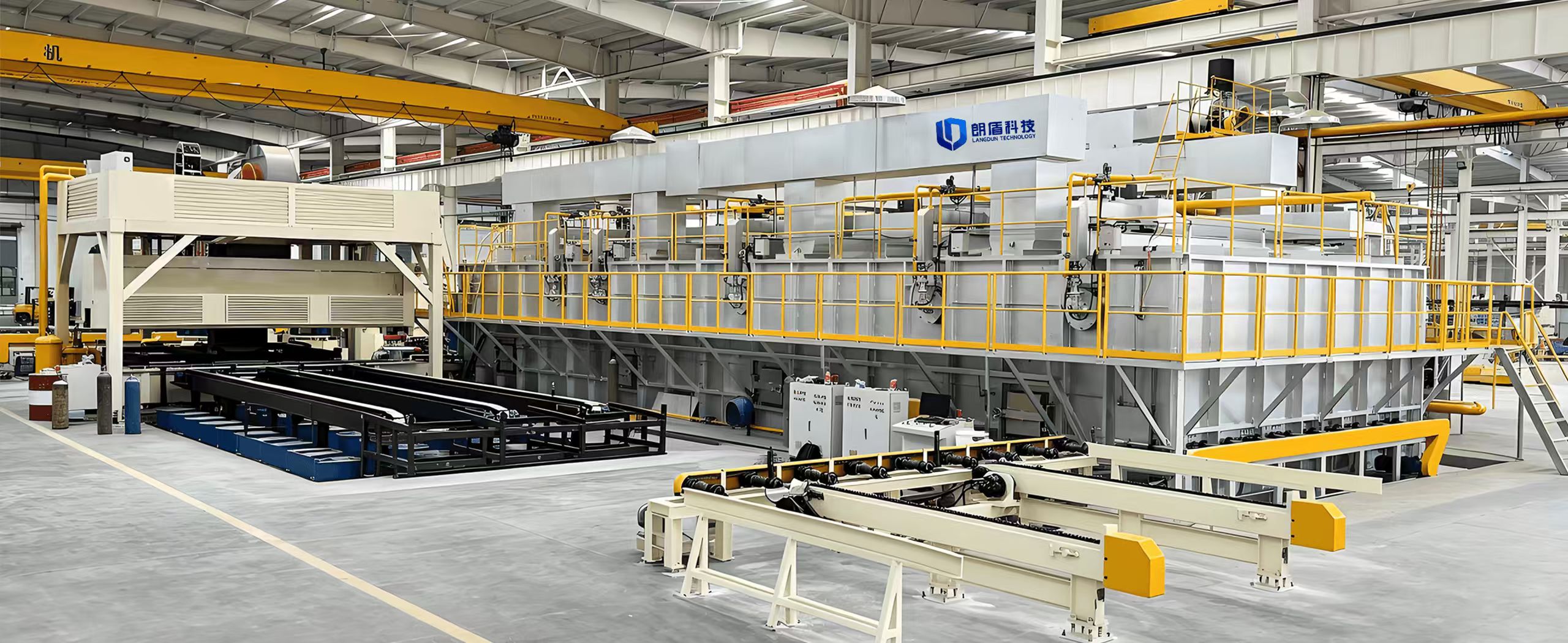
Performs high‑temperature homogenization treatment on aluminum cast billets prior to extrusion, eliminating internal segregation and coarse crystalline phases of ingots, optimizing the metallographic structure of aluminum materials, and improving the quality of subsequent extruded, anodized and sprayed finished products.
Continuous Constant‑Temperature Holding & Temperature Control
Adopts segmented temperature‑zone design with divided temperature control for heating zone, soaking zone and slow‑cooling zone. It stably maintains the homogenization temperature required by the process throughout operation with no local temperature deviation.
Automatic Continuous Feeding & Discharging
Equipped with roller‑table conveying system for continuous non‑stop travel of full‑length aluminum billets. Feeding, heating, soaking and discharging are fully automated without batch loading and unloading for individual furnaces.
Precise Temperature Control & Closed‑Loop Heat Recovery
Multi‑point temperature‑measuring probes are installed to monitor furnace temperature in real time. Matched waste‑heat recovery device recovers high‑temperature residual heat from discharged hot billets to pre‑heat incoming cold aluminum billets.
Sealed Atmosphere Protection
The enclosed furnace body reduces high‑temperature oxidation of aluminum billets, lowers surface peeling and oxide‑scale loss, and raises material yield rate.
Flexible Compatibility with Multi‑specification Aluminum Billets
Compatible with aluminum‑alloy cast billets of varying diameters and lengths. Only conveying speed and temperature‑zone parameters need adjustment for specification change, supporting multiple alloys including 6061, 6063 and 7005.
Speed‑linked Process Adjustment
Frequency‑conversion speed regulation for conveying roller tables. Travel speed is adjusted according to aluminum‑billet material and diameter to match required holding time and guarantee qualified homogenization performance.
II. Main Advantages
1. Production Efficiency
Enables 24‑hour non‑stop continuous production with no waiting time for intermittent furnace loading and unloading, delivering far higher capacity than box‑type batch homogenizing furnaces.Automated roller‑table conveyance minimizes manual intervention. Large‑volume aluminum‑billet processing can be realized per shift, suitable for large‑scale mass production in major aluminum profile plants.
2. Product Quality
Billets pass through constant‑temperature soaking zone at uniform speed. Minimal radial and axial temperature difference exists across the full billet length for consistent and homogeneous metallographic structure.It effectively resolves hard crystal and segregation defects of cast billets. Extruded profiles are free of surface pitting and color difference; anodizing presents uniform color tone and rejects rate is reduced.
3. Energy‑saving & Cost Performance
The waste‑heat recovery heat‑exchange system pre‑heats cold billets by utilizing heat from discharged hot billets, greatly cutting natural gas / power consumption.Sealed thermal‑insulation furnace structure minimizes heat loss, achieving 20%‑40% comprehensive energy saving compared with batch‑type homogenizing furnaces.Continuous stable heat supply avoids massive heat waste caused by repeated temperature rise and fall in batch furnaces.
4. Labor‑saving Operation
The whole‑line automated roller‑table workflow only requires 1‑2 on‑site operators. Frequent hoisting and furnace‑door opening‑closing operations are eliminated.Fewer high‑temperature operations from repeated furnace‑door opening reduce labor intensity and high‑temperature safety hazards.
5. Low Loss & High Material Yield
Sealed furnace chamber suppresses high‑temperature oxidation of aluminum billets, generating less oxide scale and lowering cutting loss.Collision scratches from batch loading‑unloading are avoided. Aluminum billets keep intact appearance and extrusion yield rate is improved.
6. Process Stability
Independent segmented temperature control delivers stable and controllable heating, soaking and slow‑cooling process curves, ensuring high heat‑treatment consistency among all billet batches.Data can be recorded and stored. Full‑traceability of temperature and conveying speed facilitates quality inspection and standardized process management.
7. Site Layout & Adaptability
Straight‑line layout can directly connect roller tables of casting‑billet workshop and extrusion workshop to realize integrated assembly‑line production and save intermediate stacking space.Production capacity can be expanded on demand: output can be increased by extending furnace body and adding temperature zones to meet enterprise capacity‑expansion requirements.



 Power by:
 Hanelink.com